Pictured below is a hilltop bend in the road
with a cafe for dining at Lucia. It's population is not large and commerce
is at a minimum, so we have included this photo and general information
about the Santa Lucia Mountains for your interest. Lucia is located on
Highway 1 in the Big Sur region of California's Central Coast and overlooks
the Pacific Ocean.
The cafe in Lucia has a spell binding view deck -- you
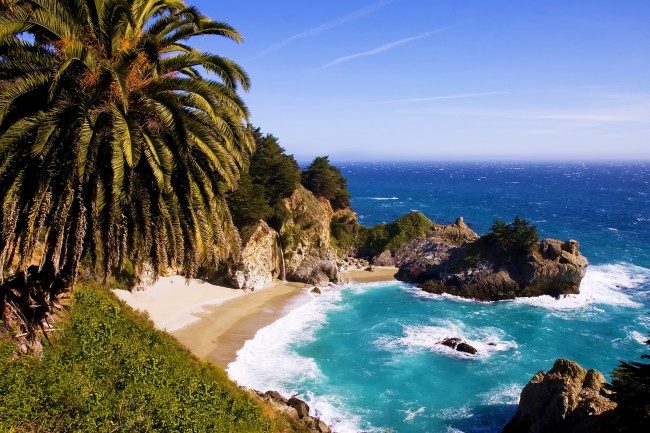
can see along the cliffs and openings of jade coves and out to the dramatic
promontory of Cape Martin very good food, and seems to always sport very
personable, lively wait staff.
The Big Sur Coast of Central California
is over seventy miles in length and stretches from the Carmel area on the
north, south to the San Luis Obispo County line near San Simeon. The eastern
boundary is the western slopes of Santa Lucia Mountains; the western boundary,
the Pacific Ocean.
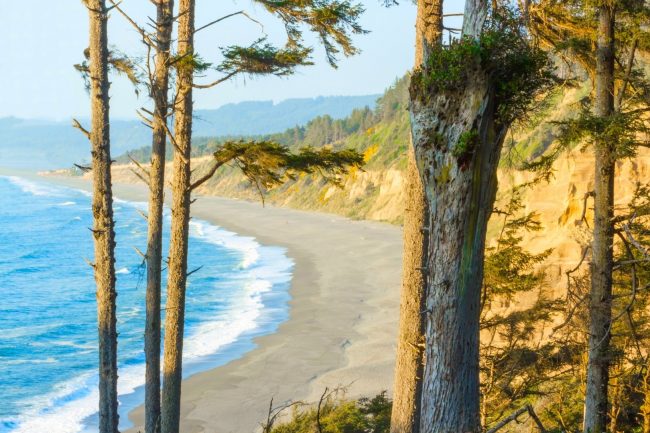
The western slopes of the Santa Lucia Mountains,
reaching an elevation of 5,200' at Cone Peak, drop precipitously to the
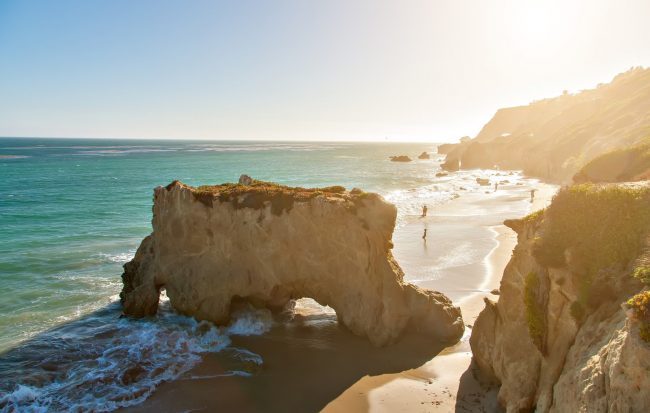
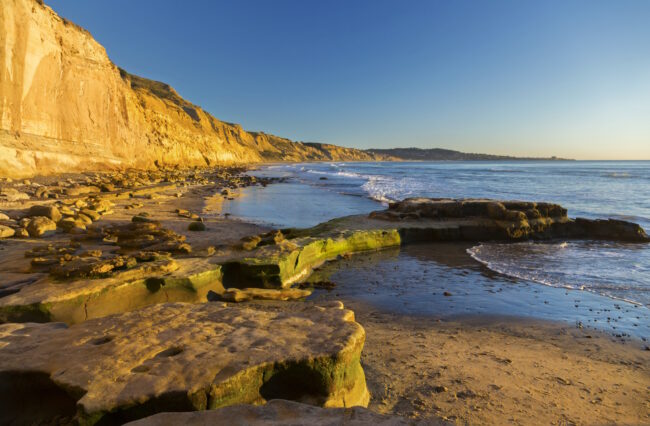
sea. Much of the coast is bounded by sheer cliffs. Great offshore rocks
punctuate the dramatic meeting of land and sea. Beaches are few; strong
currents, waves and cold water make swimming hazardous. Nearly fifty separate
streams flow down the mountains to join the sea. Several of these, such
as the Big Sur and Little Sur Rivers, Big Creek, Garrapata Creek and Salmon
Creek, have substantial year-round flows and support migrating as well
as resident fish. The Big Sur coast is rich in plant
and wildlife diversity. Coast redwoods are found in the cool, moist canyons.
The Santa Lucia fir and many other rare plants are present. Mountain lion,
deer and many smaller terrestrial animals and birds make Big Sur their
home. The California sea otter refuge runs the length of the coast, providing
safe harbor for the sea otter, perhaps the most playful member of the coast's
diverse marine wildlife.
The climate in Big Sur is mild. Although
the winters bring some of the heaviest rainfall in California, the summers
are long and dry. Coastal fog is typical on summer mornings near the shore,
while inland and at the higher elevations temperatures can get quite high.
The rugged mountainous terrain of the Big
Sur coast has had a profound effect on historical use of the area and will
continue to serve as a limitation on the kinds of activities that can be
carried on and the scale of development. Natural constraints to development,
including availability of water, difficult access and unstable soils on
steep slopes require extra care and imaginative solutions when contemplating
new land uses.
The scenic qualities and the natural grandeur
of the coast which result from the imposing geography, the rich vegetative
compositions and the dramatic meeting of land and sea are the area's greatest
single attraction. Big Sur has attained a world-wide reputation for spectacular
beauty.
Although it has remained a rural area where
sturdy pioneering families still carry on ranching, Big Sur's residents
have also achieved acclaim for their cultural contributions. Many well-known
writers, artists and artisans have been inspired by the coast's dramatic
vistas and timeless solitude. A strong community identity continues to
attract new residents. Today, tourism and private residential development
are the strongest trends affecting management of the area.
Approximately half of the areas 150,000
acres le within the Los Padres National Forest and the Ventana Wilderness.
Nearly 10,000 acres are contained within units of the State Park System.
Approximately 60,000 acres are in private ownership.
Historical settlement of the Big
Sur coast was initiated by the Mexican Government in the late 18th century
with the bestowal of two land grants-the 8,949 acre Rancho El Sur (between
the Little Sur River and what is now called Cooper Point) and Rancho San
Jose y Sur Chiquito, an 8,876 acre grant, bounded on the north by the Carmel
River and on the south by Palo Colorado Canyon.
With the United States occupation, unappropriated
public lands in California became available to settlers in parcels of 160
acres. Big Sur was initially settled by a number of homesteaders whose
names are now borne by well known topographic and natural features in Big
Sur (e.g., the Pfeiffers, Carlie Bixby and Jim Anderson).
The development of a tan bark industry
in the mid-1870's led to the construction of several landings along the
Big Sur Coast. These landings were used for loading the bark (used in the
manufacture of tannic acid), as well as for shipping redwood lumber. Among
them was Godfrey Notley's Landing, near the mouth of the Palo Colorado
Canyon, around which a thriving village sprang up. Jim Anderson also had
a landing and there was another at the mouth of the Big Sur River. Perhaps
the most spectacular was Partington Landing. The Rockland Cement Company
chose Limekiln Canyon as its headquarters in the 1880's in order to exploit
a rich deposit of calcareous rock discovered in the vicinity of the canyon.
Schooners began to regularly frequent Rockland Landing to load limestone
bricks and deliver supplies. With the demise of the liming operation, the
days of industrial enterprise along the Big Sur coast came to an abrupt
halt.
The discovery of gold near the head of
Alder Creek led to the Big Sur Gold Rush of the 1880's. The Los Burros
Mining District sprang into being with three stamp mills and a boomtown
named Manchester mushroomed on Alder Creek. In its heyday, Manchester boasted
four stores, a restaurant, five saloons, a dance hall and a hotel. By 1895
the boom had begun to fade.
As the 19th century drew to a close, more
settlers came to live on the south coast. The two sons of one of the original
homesteaders, Bill Post, each homesteaded 160 acres, while various relatives
acquired tracts totaling another 640 acres. Their land stretches as far
south as the site of the present-day Nepenthe Restaurant. The ranchhouse
still stands on Highway 1 at the top of what is now called "Post Grade".
Big Sur's original post office and its second schoolhouse were built on
the Post Ranch.
The 20th century saw the emergence of recreation-oriented
commercial development along the Big Sur Coast. For decades, the Big Sur
country had been attracting hunters and fishermen. The start of the resort
business began with the Pfeiffer Ranch Resort, which catered to these sportsmen.
The Hotel Idlewild, located on the banks of the Little Sur River, soon
rivaled the Pfeiffer Ranch for its business.
The one deterrent to the development of
the south coast as a Mecca for tourists as well as sportsmen, was the hazardous
road that had to be closed part of the year. The concept of a year-round
scenic highway originated with Dr. John Roberts, the founder of the City
of Seaside.
Many of the original settlers were enraged
by the devastation resulting from the highway construction. Machinery blasted
through the great cliffs, scarring granite promontories, defiling canyons
and waterfalls with debris. On June 27, 1937, the highway was completed
at a cost of approximately $8,000,000. A way of life had ended and a new
era began for the beautiful country.
The process of ensuring the long-term protection
of Big Sur's unique coastline was initiated by John Pfeiffer in 1934 when
he sold 706 acres to the State for the nucleus of the 822 acre Pfeiffer
Big Sur State Park. The Lathrop Browns, who purchased Saddle Rock Ranch,
later donated 1,700 acres which now constitutes Julia Pfeiffer Burns
State Park. The 21 acre John Little State Park, originally part of the
Slate property sold to Milton Little, was donated by Elizabeth Livermore.
Francis Molera, granddaughter of Juan Bautista Roger Cooper, placed 2,000
acres in trust for Andrew Molera State Park. The generosity of these pioneering
families has been a lasting contribution to the preservation of Big Sur
and the people of Monterey County and the State.
The history of development in Big Sur reflects
the changing demands for use of the land. Subsistence ranching, logging
of redwoods, harvesting tan bark and mining of limestone and gold provided
a livelihood for early residents. While life was extremely rugged in these
early years, there was a population of nearly 1,000 people by the 1880's
largely supported by these basic industries. The mountain terrain, numerous
deep canyons and lack of roads made travel difficult and slow. Most local
products were shipped out by sea on the small coastal trading vessels that
brought supplies to the isolated coast's residents. Palo Colorado Canyon,
Notley's Landing, Bixby Creek, the Big Sur Valley and Partington Canyon
were early centers of activity. Around the turn of the century, limited
recreational use of the coast began to occur. The Big Sur Valley could
be reached by stage from Monterey and camping in the redwood groves grew
in popularity. Hunting and trout fishing were also popular and some local
residents supplemented their income by guiding sportsmen from the cities.
Today, the tan bark, lumber and limestone
industries have ceased. Gold is still mined on a limited basis in the Los
Burros region and a few trees are harvested along the coast. Ranching continues
as the major use of the large private holdings and contributes much to
the character of Big Sur. Public recreation and private residential development
are by far the strongest land use trends today.
Single family residences comprise a major
developed land use on private land. This occurs either in rural residential
clusters in areas where development has historically been concentrated
or scattered along Highway One. Many of the larger parcels are used for
cattle grazing. Commercial uses, including restaurants, grocery stores
and service stations are generally concentrated in the Big Sur Valley,
Gorda and a few isolated businesses along Highway One. Recreational uses
include public and private campgrounds, visitor accommodations, restaurants,
State Park units and the Los Padres National Forest. The U.S. Forest Service
has offices and other facilities in the Big Sur Valley and at Pacific Valley.
State Parks and Recreation manages its units in Big Sur from offices in
the Big Sur Valley. Caltrans has maintenance facilities in the Big Sur
Valley and at Gorda. Quasi-public uses serving the local community and
the traveling public are located in the Big Sur Valley. These include the
Big Sur Grange hall, Captain Cooper Elementary School, churches, the County
Library, Post Office and new Multi-Agency Conference Center.
There are approximately 1,100 parcels in
private ownership on the Big Sur Coast, ranging in size from less than
an acre to several thousands of acres. Approximately 790 are vacant and
370 are occupied. Many have more than one unit on them, either residential
or commercial. Small parcels of 2.5 acres or less are generally located
near the highway, particularly between the highway and the ocean in a few
specific locations including Palo Colorado Canyon, Garrapata Redwood, Rocky
Point, Big Sur Valley, Coastlands and Partington. These areas have the
greatest number of developed parcels.
Approximately 2/3 of the Big Sur coastal
zone is in public ownership under the U.S. Forest Service, the State Department
of Parks and Recreation, the U.S. Navy, the U.S. Coast Guard and
the University of California. If public acquisitions now contemplated or
in progress are completed, approximately 60% of the coast will be publicly
owned. Some of the private lands have scenic easements or deed restrictions,
which limit the level of development.
The 1990 decade census recorded approximately
800 housing units of which approximately 600 were single family dwellings.
Large proportions of these homes are located in several residential areas.
While there are historic expectations the buildup of these areas will be
allowed to proceed, there are a number of conflicts with the broad objectives
of the land use plan, particularly visual protection and protection of
water resources.
Residential areas include: Otter Cove,
Garrapata Ridge/Rocky Point, Garrapata and Palo Colorado Canyons, Bixby
Canyon, Pfeiffer Ridge/Sycamore Canyon, Coastlands, Partington Ridge, Burns
Creek, Buck Creek to Lime Creek, Plaskett Ridge and Redwood Gulch. The
Big Sur Valley, Lucia and Gorda also have significant residential
use, although the primary functions of these areas are community service
and commercial.
As a recreational area of regional, national
and international importance, Big Sur attracts nearly 4.5 million visitors
annually. The accessibility of Big Sur to several nearby population
centers is a major factor contributing to its high visitation. The basic
recreational resource of Big Sur is the visual beauty of its striking landforms
and unspoiled landscape. The mountains, forests, creeks, rivers and ocean
shoreline combine to offer diverse recreational opportunities. The artistic
and rustic lifestyle for which Big Sur is known creates an attractive cultural
setting that compliments the natural character of the area.
Recreational activity is concentrated along
the coastal strip: on beaches, rocky shoreline, public parks, forest lands,
campgrounds off Highway One and various visitor serving facilities.
The Big Sur Valley has numerous camping,
lodging, dining and other visitor serving facilities and is the focal point
for recreational activity and services in Big Sur. The Big Sur River, the
beach at the river mouth, the redwoods in the valley and Pfeiffer Beach
are major natural resources in the area.
The Los Padres National Forest occupies
much of the area south of the Big Sur Valley. The national forest is a
major hiking, backpacking and camping area. Several trailheads offering
access to the backcountry and the Ventana Wilderness are located off Highway
One. Several beaches including Sand Dollar Beach, Mill Creek Beach and
other smaller pocket beaches are scattered along the southern Big Sur Coast
within the boundaries of the National Forest. Hiking trails are scattered
throughout the Ventana Wilderness and the National Forest backcountry.
Day use facilities are provided at Mill Creek, Sand Dollar Beach, Willow
Creek and Pfeiffer Beach.
The above has been extracted from the Monterey
County Big Sur Coast Land Use Plan.
LUCIA, CA
INFO: 831.667.2391
Highway 1 Big Sur, California Monterey County