|
HUMBOLDT COUNTY
Eureka

Eureka to LAX story
Eureka / Arcata Airport
Farmer's Market
Historical Landmarks
Events
Blues by the Bay Festival
Redwood Jazz Festival
HUMBOLDT COUNTY
Arcata
Eureka
Fernbridge
Ferndale
Fields Landing
Fortuna
Garberville
Loleta
Lost Coast
Redcrest
Samoa
Weott
Eureka Hotels
|
|
Humboldt County,
California Photos, Information, Hotels and Map |
|
|

Humboldt County is
the gateway to the Pacific Northwest. The County is bound on
the north by Del Norte County; on the east by Siskiyou and Trinity
counties; on the south by Mendocino County and on the west by the
Pacific Ocean. One of 58 California
Counties, Humboldt County encompasses 2.3 million acres, 80 percent of
which is forestlands, protected redwoods and recreation areas.
The northern part of the County includes the City of Trinidad, Orick;
Redwood National Park; Prairie Creek and Humboldt Lagoons State Parks;
and several State Beaches.
The eastern part of the County includes Willow Creek, Hoopa Valley
Indian Reservation, Orleans, and a great deal of Six Rivers National
Forest land.
The southern part of the County includes Alton, Carlotta, Hydesville,
Rio Dell and Scotia; the Avenue of the Giants communities; Garberville
and Redway; the Eel, Mattole and Van Duzen River communities; Humboldt
Redwoods, Richardson Grove and Grizzly Creek State Parks; and the King
Range National Conservation Area.
The southern border of the County is located 225 miles north of San
Francisco, the closest major metropolitan city. The County is linked by
Coastal Highway 101 to the rest of California to the South and the
Oregon Coast to the North. Highway 299 links the County to Interstate 5
to the east. The County airport in McKinleyville has daily flights to
San Francisco, Sacramento, Portland and Seattle. Source:
www.co.humboldt.ca.us
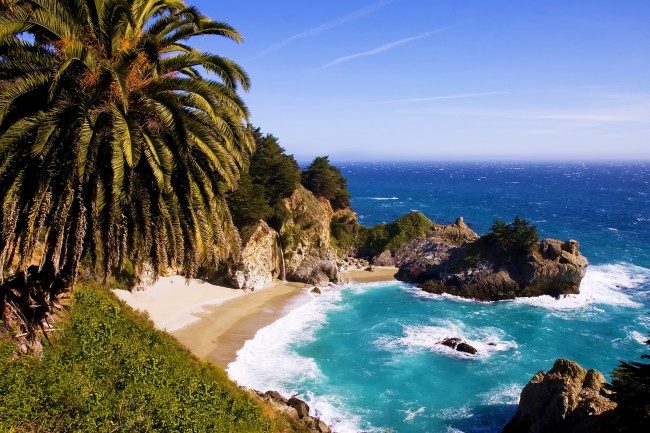
Humboldt County Beach Cities
Trinidad, McKinleyville, Arcata, Eureka, Loleta, Ferndale, Honeydew &
Petrolia, Shelter Cove
|
Humboldt County Beach List 1. Dead Man's Beach
2. Shelter Cove 3. Little Black Sands Beach 4. Black Sands Beach
5. Mattole River Beach 6. Centerville Beach Co. Park 7. Crab County Park
8. South Spit & Jetty 9. Samoa Dunes Rec. Area 10. Mad River Beach C. Park
11. Clam Beach County Park 12. Little River Beach Co. Park
13. Moonstone Beach 14. Luffenholtz Beach
|
15. Baker Beach
16. Indian Beach
17. Trinidad Head
18. Trinidad State Beach
19. College Cove
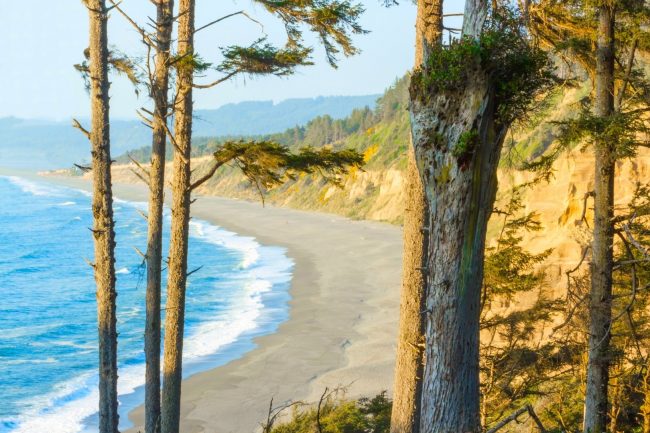
20. Agate Beach
21. Big Lagoon County Park
22. Dry Lagoon
23. Stone Lagoon
24. Freshwater Lagoon
25. Redwood Creek Beach
26. Orick Fishing Access
27. Gold Bluffs Beach
28. Carruthers Cove Beach |
|
Humboldt County Historical Landmarks
NO. 146 TRINIDAD HEAD - On June 11, 1775, Bruno de
Hezeta, commandant of an expedition up the northwest coast, marched with
his men and two Franciscan fathers from the shore of the bay to the
summit of Trinidad Head. Here they erected a cross and took possession
in the name of Charles III of Spain.
Location: 1.5 mi W of Hwy 101, Trinidad, USCG Station
NO. 154 FORT HUMBOLDT - By the early 1850s, newly arrived white settlers
had moved into the Humboldt Bay area, causing conflict with the native
inhabitants. To protect both Indians and settlers, Fort Humboldt was
established in 1853 and operated until 1866. It became a focal point in
the violent struggle between two cultures. Many Native Americans were
assembled here before removal to reservations.
Location: 3431 Fort Ave, Eureka
USGS Quadrangle Sheet Name: EUREKA
NO. 164 THE OLD ARROW TREE - This site is said to have been used by
Indians to commemorate an important peace treaty. In memory of the
treaty, each tribe, upon passing, was supposed to have shot an arrow
into the bark.
Location: 0.8 mi E of Korbel County Hwy F5L 100 (P.M. 2.2), Korbel
NO. 173 CENTERVILLE BEACH CROSS - On January 6, 1860 the steamer
Northerner, northward bound from San Francisco, struck a hidden rock two
miles off Cape Mendocino, and from there drifted to the Centerville
Beach. Thirty-three passengers and 32 crew members were saved - the
cross was erected by the Ferndale Parlor No. 93, N.D.G.W., in memory of
the 17 passengers and 21 crew members who lost their lives in this
disaster.
Location: 5 mi W of Ferndale on Centerville Rd (P.M. 0.8)
USGS Quadrangle Sheet Name: FERNDALE
NO. 215 CAMP CURTIS - Camp Curtis was the headquarters of the Mountain
Battalion from 1862 to 1865. There were many military posts established
throughout this area for the protection of the white settlers. (Army
spells Curtis with one s.)
Location: Take Sunset Ave offramp Hwy 101, go N 0.9 mi on L. K. Wood
Blvd frontage Rd, Arcata
NO. 216 TOWN OF TRINIDAD - Founded April 8, 1850, Trinidad is the oldest
town on the Northern California coast. During the 1850s, it served as a
vital supply link between ships anchored at Trinidad Bay and miners in
the Klamath, Trinity, Salmon River, and Gold Bluff mines. It was the
county seat of Klamath County (now disbanded) from 1851 to 1854, but its
population declined as Eureka and other area port cities developed.
Location: NW corner of Edwards and Hector Sts, Trinidad
NO. 477 CITY OF EUREKA - Eureka was founded as a town in 1850 and
incorporated as a city in 1874. Located on the remote northwestern coast
of California, Eureka was the region's major port of entry by water in
the 19th century before the construction of good access by land, and
rose to historical prominence as the major social, political, and
economic center of the region. 'Eureka' is a Greek expression and a
popular mining term meaning 'I have found it.'
Location: NW corner, 3rd and E Sts, old town, Eureka
NO. 543 CALIFORNIA'S FIRST DRILLED OIL WELLS - California's first
drilled oil wells that produced crude to be refined and sold
commercially were located on the North Fork of the Mattole River
approximately three miles east of here. The old Union Mattole Oil
Company made its first shipment of oil from here, to a San Francisco
refinery, in June 1865. Many old well heads remain today.
Location: NE corner Mattole Rd and Front St, Petrolia
NO. 783 JACOBY BUILDING - The basement and first story of this building
were constructed in 1857 for Agustus Jacoby, and housed various
mercantile firms during its early years as a principal supply point for
the Klamath-Trinity mining camp trade. It served occasionally as a
refuge in time of the Indian troubles from 1858 through 1864. It was
acquired by A. Brizard in 1880.
Location: Eighth and H (plaque at NE corner, structure at SE corner),
Arcata
USGS Quadrangle Sheet Name: EUREKA 15
NO. 838 OLD INDIAN VILLAGE OF TSURAI - Directly below was located the
Yurok village of Tsurai. A prehistoric permanent Indian community, it
was first located and described by Captains Bodega and Heceta, June
9-19, 1775. The houses were of hand-split redwood planks, designed for
defense and protection. The village was occupied until 1916.
Location: SW corner of Ocean and Edwards Sts, Trinidad
NO. 842 ARCATA AND MAD RIVER RAIL ROAD COMPANY - Incorporated December
15, 1854, as the Union Plank Walk, Rail Track, and Wharf Company, the
Arcata and Mad River Rail Road is the oldest line on the north coast.
Originally using a horse-drawn car, the railroad served as a link
between Humboldt Bay and the Trinity River mines. Later, locomotives
were added as the line grew to serve the redwood industry.
Location: 330 Railroad Ave, NW corner Hatchery Rd and Railroad Ave, Blue
Lake
USGS Quadrangle Sheet Name: BLUE LAKE 15
NO. 882 HUMBOLDT HARBOR HISTORICAL DISTRICT - Captain Jonathan Winship
made the first recorded entry into Humboldt Bay by sea in June 1806, and
Josiah Gregg's party visited the bay in 1849. By 1850 the Laura Virginia
Association had founded Humboldt City, Union (Arcata), Bucksport, and
Eureka - in subsequent years, the bay became a major North Coast lumber
port and shipbuilding center.
Location: Harold Larsen Vista Pt, Humboldt Hill Rd off Hwy 101 (P.M.
73.7), Eureka
NO. 883 FERNDALE - This pioneer agricultural community, settled in 1852,
helped feed the booming population of mid-century San Francisco. Long
known as 'cream city,' Ferndale made innovative and lasting
contributions to the dairy industry. Local creameries, and the town's
role as a transportation and shipping center in the late 19th and early
20th centuries, fostered prosperity that produced Ferndale's outstanding
Victorian-Gothic residential and false-front commercial architecture.
Location: Ferndale City Hall Park, intersection of Main and Herbert Sts,
Ferndale
|
|
|
|
|